Impact–Driven Value Creation: How investors can align impact with financial performance
New Publication
A new publication co-developed by Trill Impact and Value for Good (VfG) explores how investors can generate both financial returns and measurable impact by applying impact–driven value creation systematically along the investment lifecycle.

Why This Matters
With impact assets under management exceeding $1.5 trillion globally*, the ability to demonstrate tangible impact and strong financial returns has become a key requirement for impact investors, especially in times of economic uncertainty.
While the link between impact and financial returns has been widely discussed, practical guidance on how to implement impact-driven value creation in practice has remained limited. This publication aims to address this gap by introducing a structured framework for impact-driven value creation, demonstrating how it can be integrated along the investment lifecycle and providing practical insights from real-world case studies from Trill Impact‘s portfolio. It thereby enables investors to move from ambition to execution, and is especially relevant for impact private equity firms and portfolio companies seeking to strengthen how impact contributes to value creation.
The Framework
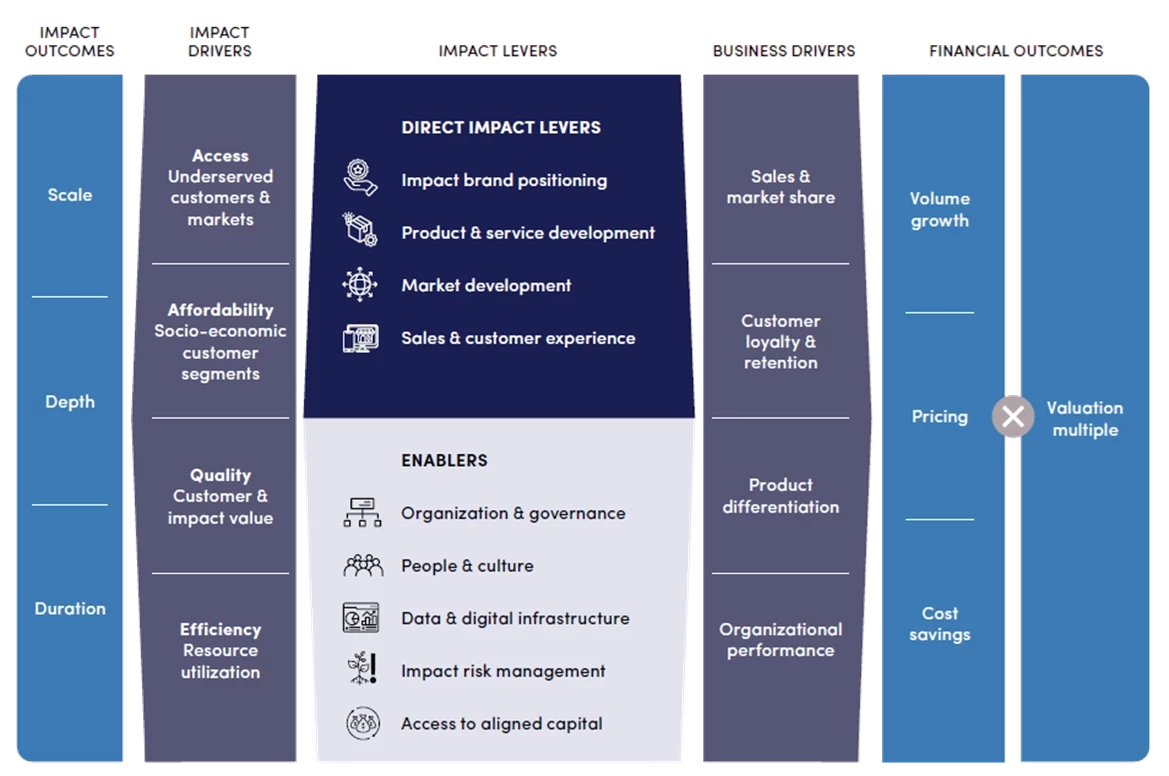
The framework presents nine impact-driven value creation levers with selected initiatives. It distinguishes between direct and enabling levers, where direct levers link to core business activities, and enablers support and amplify direct levers. Moreover, the framework aims to facilitate the understanding of causal pathways in a quantitative and qualitative manner by showing how initiatives can be linked to impact and financial outcomes via impact and business drivers.
Overall, it seeks to enable investors to customize initiatives to the unique characteristics of a company’s business model and maturity, to think through causal pathways, and based on this, to prioritize the initiatives with the highest impact and financial value creation potential.
Key Insights
Five aspects can support investors in turning impact-driven value creation into a competitive advantage:
1. Use of framework to prioritise initiatives on both impact and financial dimensions
Impact–driven value creation initiatives are most effective when designed with an explicit logic of how they contribute to both impact and financial outcomes.
2. Embedding impact–driven value creation across the investment lifecycle
While most value creation happens during the holding period, its foundation starts at sourcing.
3. Phased and iterative implementation with enablers supporting direct initiatives
The strongest results are observed when initiatives are combined and implemented in a phased and iterative manner.
4. Quantification of outcomes when possible
Quantifying impact and financial outcomes (esp. expected EBIT/EBITDA effects and EV uplift) is important to evaluate success and supports initiative prioritisation and steering during the holding period.
5. Systematic learning
Leveraging the framework, investors can consolidate learnings from initiatives, collect comparable data across portfolio companies and document successes and barriers.
Case Studies
At the heart of the publication are six case studies from Trill Impact’s portfolio companies, demonstrating how impact–driven value creation and selected initiatives are applied across different sectors and business models. Each case study highlights the use of a direct initiative and, if applicable, its supporting enablers.
Where feasible, the case studies quantify the impact and financial outcomes resulting from the initiatives, including EBIT/EBITDA effects and EV uplift. While Trill Impact does not currently measure the EV uplift from the initiatives, Value for Good proposes how this could be estimated. This quantification helps to demonstrate the tangible benefits of the initiatives and supports informed decision-making.
Case Study Example
Karriere Tutor
A leading digital provider of government-subsidised professional training
With the support of Trill Impact, Karriere Tutor systematically integrated a skills gap assessment as an additional criterion for product development prioritisation. Two enablers support the implementation of the initiative:
(1) Training of the product development team on the adjusted product development process;
(2) Integration of skill-gap contribution criterion to the internal ERP system to enable success tracking of the initiative.

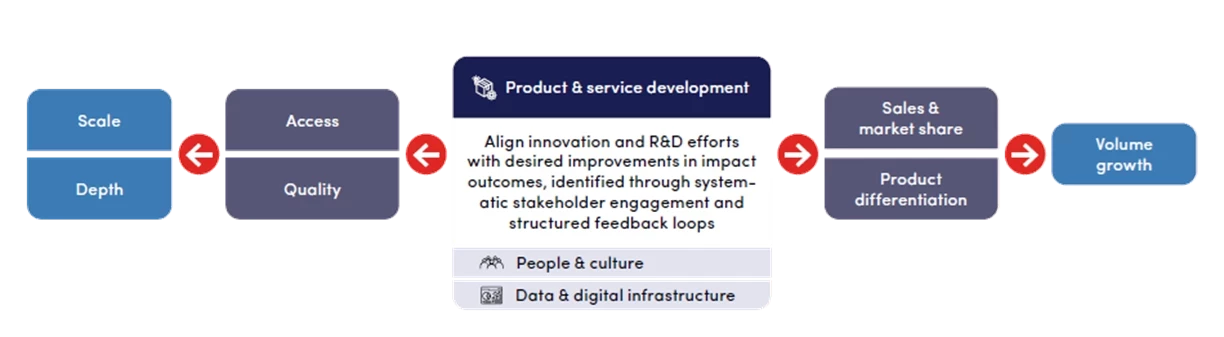
Given the digital teaching model, the immediate outcome was the creation of new courses in areas where Karriere Tutor was already active. As a second step, Karriere Tutor is expanding beyond its existing digital course portfolio to cover occupational groups with severe skills gaps, most notably in healthcare.
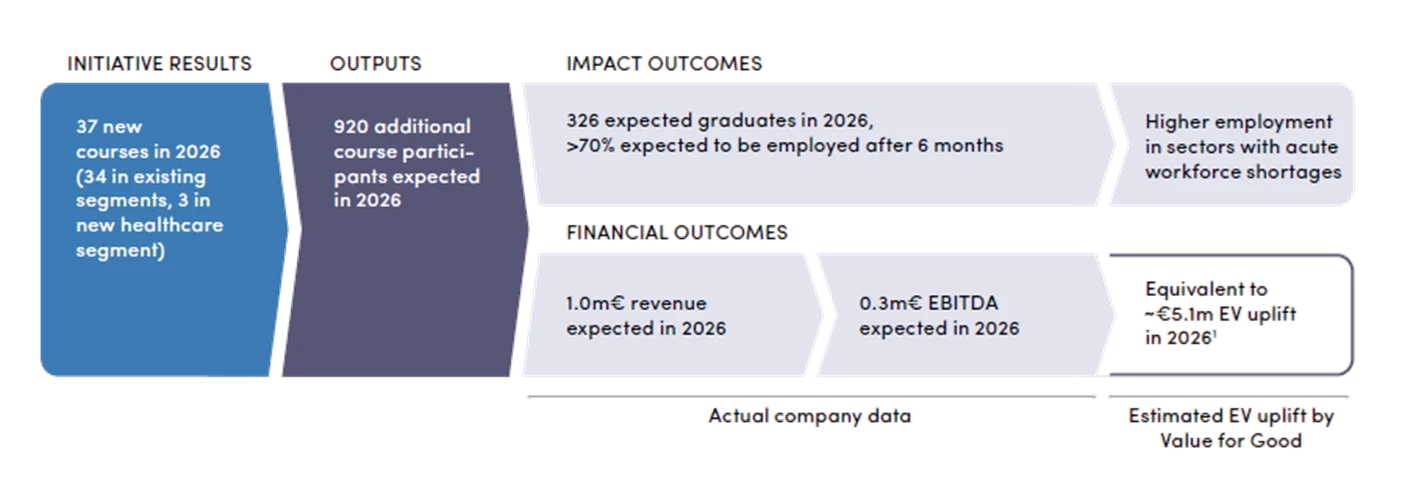
- Approximated results for indication only/no claim of accuracy – based on average industry EBITDA/EV multiple for positive EBITDA firms of 9.26 (education) and 24.48 (software – system & application) from NYU Stern/Damodaran, based on US public firms, updated January 2026, resulting in a multiple of 16.87.
Application to Your Organisation
The four strategic actions below provide practical ways to embed impact-driven value creation within your organisation and to engage with the wider impact investment ecosystem.

1. Develop a tailored framework and initiative checklist
Use the publication’s framework, nine impact-driven value creation levers and initiative library as a basis to develop a tailored framework and checklist for identifying and prioritising value creation opportunities for portfolio companies.

2. Integrate impact-driven value creation in the investment process
Integrate impact-driven value creation into the investment process from sourcing to exit, in order to identify, prioritise and phase initiatives in the most value-adding way using standard processes and templates.

3. Create strong quantified case studies from own portfolio
Develop case studies from investors’ own portfolios that demonstrate how impact and financial outcomes are linked and, where feasible, quantify the outcomes, including EBIT/EBITDA effects and enterprise value uplift.

4. Engage with and contribute to the ecosystem
Collaborate with peers, portolio companies and partners such as Value for Good to create an industry-wide repository of initiatives as a shared playbook with quantitative evidence of the link between initiatives and impact and financial outcomes.
If you‘d like to discuss how the framework could be applied within your organisation or investment strategy, please feel free to reach out to Thomas Brand, Director of Private Sector Impact at Value for Good and co-author of this publication.
The Authors
This publication is the result of contributions from many professionals and experts.

Thomas Brand, Director Private Sector Impact, Value for Good
Thomas Brand is the Director Private Sector Impact at Value for Good, where he works with traditional and impact investors and their portfolio companies on impact strategy, the integration of impact into the investment process, and impact-driven value creation. Prior to joining Value for Good, he worked at Bain & Company and the World Bank.

Hetal Damani, Impact Partner, Trill Impact
Hetal is an Impact Partner with more than 20 years of industry experience within sustainable and impact investing across the asset management industry, including private equity, public equities and private debt. Before joining Trill Impact, she held related roles at Nordea Asset Management, SEB Investment Management, 3i Group plc and ABN Amro Bank.

Niclas Düring, Impact Partner, Trill Impact
Niclas is an Impact Partner with more than 20 years of industry experience within impact and ESG investing, private equity and strategy consulting. Before joining Trill Impact, he held roles at Steward Redqueen, Swedfund International, CDC Group plc / British International Investment, McKinsey & Co., Hitachi/Celerant Consulting, and as a Consultant to the World Bank Group.

Beatriz Garabosky, Senior Consultant, Value for Good
Beatriz Garabosky is a Senior Consultant at Value for Good. Her work focuses on enabling organizations across global development, the private sector, and civil society to drive impact through their projects. Prior to joining Value for Good, Beatriz worked at the Boston Consulting Group and the United Nations.

Alice Stappen, Impact Manager, Trill Impact
Alice is an Impact Manager and before joining Trill Impact, she was a Consultant at the Boston Consulting Group, specialising in Industrial Goods, with a focus on strategy and sustainability.
New publication
Impact-Driven Value Creation: How investors can align impact with financial performance

This publication was co-developed by: